

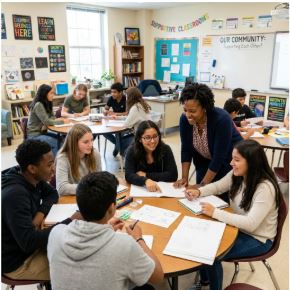

Walk into two different classrooms and you will immediately sense the difference. In one, students are restless, disengaged, quietly tolerating the lesson rather than participating in it. In the other, there is a calm kind of activity: students focused, contributing, willing to try. The physical space, the tone of the room, and the way the teacher communicates all feed into that difference. For autistic learners, this distinction is not a matter of preference. It is a matter of access.
Student engagement has long been recognised as a predictor of academic outcomes, but engagement is rarely a fixed trait within a child. It shifts in response to the environment, the demands placed on the learner, and the degree to which a student feels safe enough to participate. For many autistic students, traditional classroom settings present barriers that have less to do with capability and far more to do with design.
What Engagement Actually Looks Like
There is a common misconception that engagement means visible enthusiasm or active verbal participation. In reality, a student can be deeply engaged whilst appearing still and quiet, and visibly restless whilst genuinely processing complex information. Recognising the full range of engagement behaviours is the first step towards building a classroom that supports them.
For autistic learners in particular, engagement often looks different. It may come in bursts rather than sustained blocks. It may require a period of acclimatisation at the start of a session. It may depend on specific conditions being in place before any cognitive capacity is available for learning. Understanding this is not about lowering expectations. It is about removing unnecessary obstacles so that genuine capacity can emerge.
The Role of the Physical Environment
Sensory sensitivity affects a significant proportion of autistic students. Fluorescent lighting, background noise, unpredictable movement, and strong smells can all create a level of physiological stress that makes learning functionally impossible, regardless of how skilled or dedicated the teacher is.
Thoughtfully designed classrooms take sensory factors seriously. This includes flexible seating arrangements, access to quieter spaces within the room, predictable routines that reduce ambient anxiety, and the option to use noise-reducing tools when needed. These are not special privileges. They are reasonable adjustments that allow the brain to move out of threat response and into a state where learning becomes possible.
Physical organisation also plays a role. Clear, uncluttered spaces with visual cues about where things are and what comes next reduce the cognitive load associated with navigation and transition, two areas that frequently challenge autistic students.
Structure, Predictability, and Trust
One of the most powerful tools a classroom can offer any student is predictability. For autistic learners, a consistent, well-communicated routine can be the difference between a productive day and one spent managing anxiety.
This does not mean rigidity. It means that when changes occur, they are communicated clearly and in advance wherever possible. It means visual schedules, explicit instructions, and clear expectations around tasks and transitions. It means that students are not left to decode unstated social rules or guess what is expected of them.
When students understand what is happening and what is coming next, they can redirect energy from coping toward learning. This shift is transformative. Many parents and educators who have seen it describe it as watching a child finally able to be themselves in an educational setting, rather than spending their resources on simply getting through the day.
Educator Approach and Relationship
Beyond the physical and structural, the relational dimension of a classroom matters enormously. Students engage more readily with educators who communicate clearly, maintain consistent expectations without being punitive, and demonstrate genuine understanding of how the student experiences the world.
Specialist learning environments, such as dedicated autism schools, are increasingly recognised for their ability to provide this combination of physical, structural, and relational support in a sustained and integrated way. Rather than asking autistic students to adapt entirely to a standard model, these environments adapt to the learner, which allows engagement to develop on far more solid ground.
A Broader Shift in How We Think About Learning
The research on inclusive and specialised education continues to grow. What it consistently shows is that student engagement is not primarily a motivation problem. It is an environment problem. When the setting genuinely supports the learner, engagement follows. That principle applies across all students, but it holds particular weight for autistic young people whose access to learning depends so heavily on the conditions surrounding it.
Building classrooms that work for every student is not idealism. It is simply good educational design.